ConceptAI

Popular

Computer Vision Generative AI & RAG Defence Predictive Analytics Genomics
Insights

Perspectives from the AI Front Line

Our team writes from experience — not theory. These articles reflect the lessons, patterns, and hard-won insights from building AI systems that actually ship.

Why Most RAG Systems Fail in Production — and How to Fix ThemLLMs & RAG

Article

Why Most RAG Systems Fail in Production — and How to Fix Them

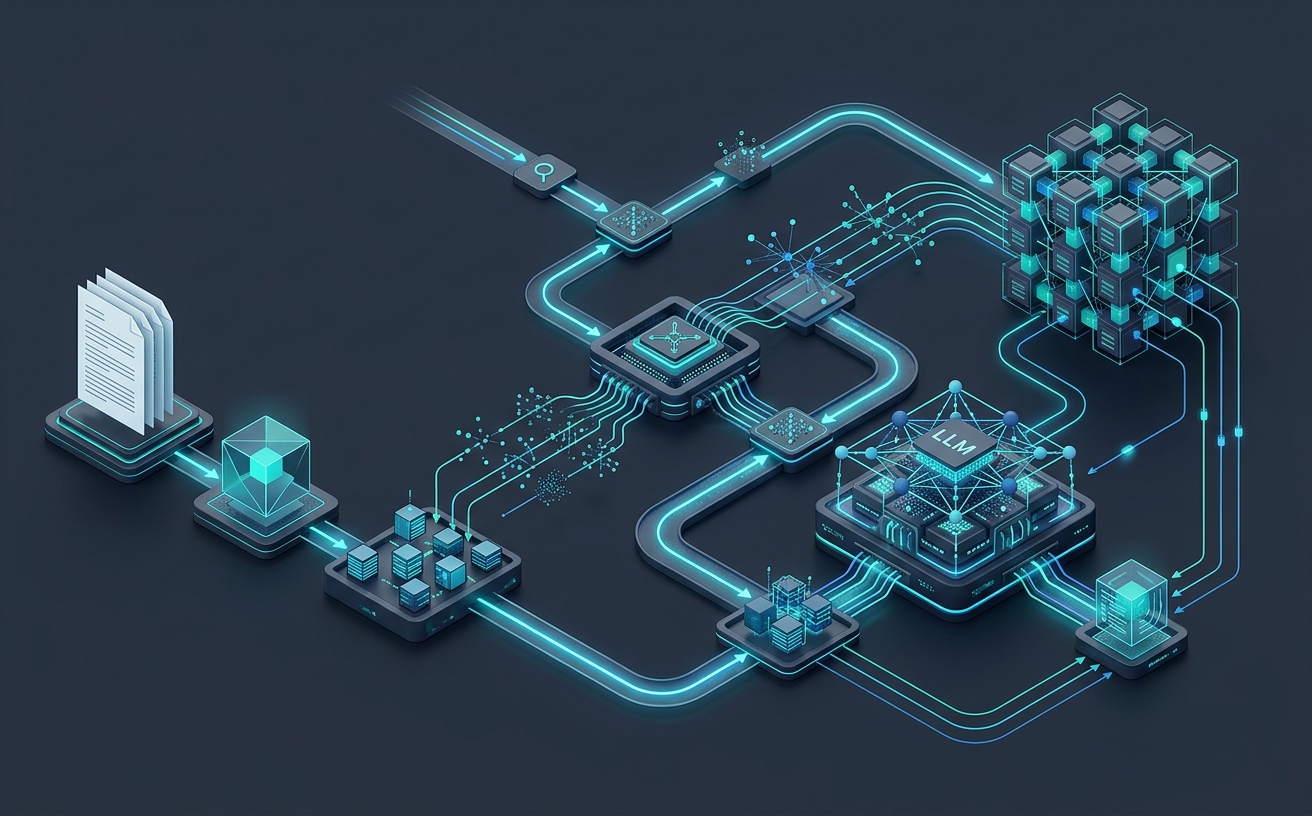
Retrieval-Augmented Generation has emerged as the dominant architecture for enterprise LLM applications. The promise is compelling: ground your language model in your own data, reduce hallucination, and give users accurate, cited answers. The reality, for many teams, falls short.

The most common failure modes we see are not model failures — they are engineering failures. Chunking strategies that ignore document structure. Embedding models that were not trained for the target domain. Retrieval pipelines that optimize for recall but not precision. Reranking stages that are absent entirely.

Three Principles for Production-Grade RAG

Chunk with meaning, not character count

Documents have semantic structure: paragraphs, sections, tables, footnotes. Chunking that ignores this structure fragments context and degrades retrieval quality. Use structure-aware chunking strategies that preserve semantic coherence.

Match your retriever to your vocabulary

Generic embedding models underperform on domain-specific text. In legal, medical, or defence contexts, fine-tuning your embedding model on domain vocabulary makes a measurable difference in retrieval accuracy.

Always add a reranking stage

First-stage retrieval is recall-optimized. A cross-encoder reranker adds precision. Without it, you are handing the LLM marginally relevant context and hoping for the best — and production systems cannot afford that.

The RAG systems we build at Concept AI follow these principles as table stakes. The result is retrieval pipelines that perform in the 90th percentile on accuracy benchmarks — not because we use better models, but because we engineer the full stack with discipline.


Edge AI in Defence: What Changes When the Network is Not ThereComputer Vision

Article

Edge AI in Defence: What Changes When the Network is Not There

Consumer AI assumes connectivity. Cloud inference APIs, model update pipelines, telemetry streams — the modern AI infrastructure stack depends on reliable network access. Defence deployments do not have that luxury.

Operating in forward-deployed, communications-restricted, or air-gapped environments requires a fundamentally different engineering philosophy. Models must be quantized for low-power hardware. Inference must be fast enough for real-time response without a GPU cluster. Updates must be packaged and deployed manually. The system must fail gracefully when inputs are degraded.

What We Have Learned Building Edge AI for Restricted Environments

Quantization matters

INT8 quantization typically recovers 70-80% of the accuracy cost of FP32 models while delivering 3-4x inference speed improvements on edge hardware.

Architecture beats scale

Model architecture matters more than model scale at the edge — EfficientDet and MobileNet variants consistently outperform scaled-down large models in constrained deployments.

Fallbacks are a feature

On-device fallback logic (rule-based detection thresholds when model confidence is low) is not a limitation — it is a safety feature that responsible edge AI systems should always include.

Field data is gold

Data collected at the edge is often the most valuable training data you will ever have. Build structured, low-overhead data collection pipelines into your deployed systems from day one.

The Three Questions Every Enterprise Should Answer Before Starting an AI ProjectAI Strategy

Article

The Three Questions Every Enterprise Should Answer Before Starting an AI Project

We speak to dozens of organizations each year that are eager to invest in AI. The conversations that lead to successful projects all have something in common: the organization has clear answers to three foundational questions before a single line of code is written.

The Three Questions

Question 1: What decision will this AI system change?

The most common source of AI project failure is a fuzzy use case. ‘Use AI to improve our operations’ is not a use case — it is a hope. A use case is: ‘Use AI to reduce false positive alerts in our surveillance system from 40% to below 10%.’ Specific, measurable, and tied to a decision that humans currently make imperfectly.

Question 2: Do we have the data to train and evaluate the model?

AI is a data-hungry technology. Before committing to a project, organizations need an honest inventory of their data — not just its volume, but its quality, labeling status, and domain coverage. The most sophisticated model architecture in the world cannot compensate for a training dataset that does not represent the real problem.

Question 3: Who owns this system after it ships?

AI systems degrade over time as the real world drifts from the training distribution. Every production AI deployment needs a named owner responsible for monitoring performance, retraining on new data, and managing model updates. Organizations that do not answer this question before project start typically find themselves with an AI system that works on day one and quietly fails by month six.

At Concept AI, we build these three questions into our engagement discovery process. Projects that cannot answer them clearly are invited to pause and answer them first — because a well-scoped, data-validated project with a named system owner has a success rate we are proud of. The alternative does not.

Why Reinforcement Learning Is Finally Ready for Industrial DeploymentReinforcement Learning

Article

Why Reinforcement Learning Is Finally Ready for Industrial Deployment

For most of the past decade, reinforcement learning was the AI discipline that promised the most and delivered the least in real industrial settings. The results in games were spectacular. The results in factories and field environments were not.

That is changing. Three developments have converged to make RL practical for industrial deployment: the availability of high-fidelity simulation environments for training without real-world risk, improved sample efficiency from algorithms like PPO and SAC, and the emergence of behavior cloning techniques that allow RL agents to bootstrap from expert demonstrations rather than learning entirely from scratch.

Our UAV path planning system is a direct example of this maturation. By combining A* expert trajectories with Actor-Critic RL architecture, we trained an agent that learned 3D navigation policies orders of magnitude faster than pure RL — and produced smoother, more reliable flight paths than rules-based planners.

The industrial RL frontier is now: robotic assembly, autonomous inspection vehicles, supply chain optimization, and adaptive process control. The engineering challenges are real — but they are solvable. We know, because we are solving them.

Want to dive deeper on any of these topics?